عضویت
عضویت  ورود اعضا
 راهنمای خرید







Battery-Based Power Supplies0 pages
CEDRAT
GROUPE
www.cedrat.com
Battery-Based Power
Supplies
Battery-based power supplies can be used in a broad range of applications for different reasons.
From the customer needing low noise power supplies for sensing equipment, to the customer
willing to drive a magneto or piezo-mechanism from an autonomous power supply in embedded
applications, Cedrat Technologies can design power supplies using high quality lithium-polymer
batteries.
Objective
The use of battery-based power supplies is a smart
solution to solve issues such as the need for:
• Systems with autonomous energy source
• High power density and efficiency
• Reduced size and weight
• Low noise
• Specific supply voltages
The targeted applications are mainly the embedded applications, where it is mandatory to have
autonomous power supplies. Low power voltage levels can be provided to supply a low-power
board such as a conditioning electronic or a digital controller. High power voltage levels can also
be provided if it is required to supply a power amplifier for a piezo-actuator for instance. For
noise sensitive electronics and components, it is also interesting to use battery-based power
supplies which allow avoiding the noise carried by the power grid. For instance, this is used
for high resolution and precision sensing equipments such as accelerometers, 3-D localizing in
medical environment.
Technology
The power supplies are based on 3.7V (typical) lithium-polymer cells which provide an unregulated
output voltage, those batteries correspond to the energy storage of the supply. The lithiumpolymer
technology is the most efficient battery technology; it is able to provide high power
in a reduced package and for a reduced weight. The cells can be arranged in serial or parallel
depending on the need for voltage, current, and operation time. This allows fitting easily with the
customer’s needs, simply by changing the cells configuration.
The supply features a smart charge circuit for the lithium polymer battery cells, which protects
the battery cells from overload and over-temperature during charge sequence. The charging
circuit is able to operate from a simple AC/DC converter
connected to the grid.
The regulated voltage levels are generated from the battery
power source using DC/DC converters, which can decrease,
elevate, or invert the input voltage from the batteries. This
means that almost any output voltage can be built from the
battery source, using those specific topologies. The DC/DC
converters exhibit very high efficiency of more than 80% in
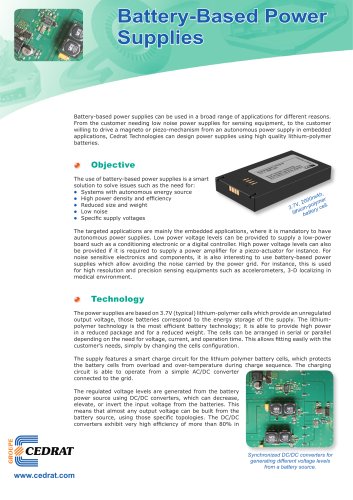
3.7V, 2000mAh,
lithium-polymer
battery cell.
Synchronized DC/DC converters for
generating different voltage levels
from a battery source.