عضویت
عضویت  ورود اعضا
 راهنمای خرید







SHPB SHTB TEST APPARATUS0 pages
Advance Instrument Inc.
Split Hopkinson Bar
High Strain Rata Material Testing
Materials undergo high strain rates deformation in various applications, e.g. accidental events such as explosions
and penetrations, and engineering applications such as crash worthiness of vehicles, bullet proof armors, impact
resistant pressure vessel and shipping cask for transport of nuclear materials. In addition to this, forming processes like
extrusion, rolling and high speed machining can also result in high strain rate deformation. For the optimal design and
safety analysis of components seeing high strain rates of loading the constitutive behavior of materials at high strain
rates is required.
Dynamic testing of material is becoming more important due to the need for more optimized crashworthiness and
impact analysis. Positive strain rate sensitivity, i.e. the strength increases with strain rate, offers a potential for improved
energy absorption during a crash event. The load can be an instant load wave used for very high strain rate. The
machine will also have the proper measurement systems to measure and record the important parameters, such as
strain, displacement and load.
Split Hopkinson Bar system, Single Bar (SB) system is the systems commonly used.
The systems has been developed by Adavnce Instrument Inc. in recent years to meet the increasing demand for
dynamic testing.
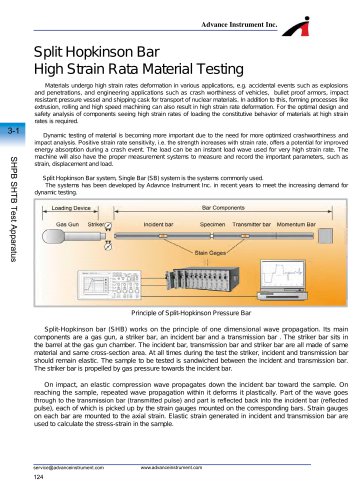
Loading Device
Gas Gun Striker^)
0
Bar Components
Incident bar
Specimen Transmitter bar Momentum Bar
Stain Gages
M ro ro I'O
-
-jwMuiiiijjjl
Principle of Split-Hopkinson Pressure Bar
Split-Hopkinson bar (SHB) works on the principle of one dimensional wave propagation, its main
components are a gas gun, a striker bar, an incident bar and a transmission bar. The striker bar sits in
the barrel at the gas gun chamber. The incident bar, transmission bar and striker bar are all made of same
material and same cross-section area. At all times during the test the striker, incident and transmission bar
should remain elastic. The sample to be tested is sandwiched between the incident and transmission bar.
The striker bar is propelled by gas pressure towards the incident bar.
On impact, an elastic compression wave propagates down the incident bar toward the sample. On
reaching the sample, repeated wave propagation within it deforms it plastically. Part of the wave goes
through to the transmission bar (transmitted pulse) and part is reflected back into the incident bar (reflected
pulse), each of which is picked up by the strain gauges mounted on the corresponding bars. Strain gauges
on each bar are mounted to the axial strain. Elastic strain generated in incident and transmission bar are
used to calculate the stress-strain in the sample.
service@advanceinslrument.com
124
www.advanceinstrumenl.com
"